Saturday, March 23, 2019

Is Jordan Peterson Racist? | Top Quora Answers


No, Jordan Peterson is not a racist.
And the simplest proof of this is that if Jordan Peterson were racist, the radical Left, who has been frothing at the mouth against his arguments and widespread appeal and are livid with their inability to come up with anything but ad hominem attacks against him, they would had used it to publicly crucify him.
Attacks I expect to intensify if he does decide to run for office in Canada (and finally oust that insufferable SoyBoy hypocrite who inherited the Prime Minister position on his family name alone and keeps fake-virtue signaling to coverup his severely wanting ethics).
After all, the SJWs seem to have perfected Goebel’s practices of repeating a lie until it starts to sound like a truth. Yet, I seriously doubt that anyone can find anything that could actually substantiate such an outrageous claim.

Source: Quora

What are thoughtful gifts presented by countries to each other? | Top Quora Answers

The Statue of Liberty was designed by French sculptor Frédéric Auguste Bartholdi, its metal framework was built by none other than Gustave Eiffel, the chief engineer was Eugène Viollet-le-Duc, responsible for the restoration of almost all the best-known medieval sites in France. Finally, the statue itself and its transportation to the United States was financed by France (only the pedestal was made and financed by Americans).
The head of the statue at Paris World Fair in 1878
The statue referenced both the independence of the USA (explicitly) and the end of slavery (implicitly): one of the first projects included broken chains but it was abandoned in order not to anger the Southerners. It also reflected the memory of French assistance in the American Revolutionary War and the longing of now isolated France to reclaim the old friendship with the USA.
Unveiled in 1886, the Statue of Liberty became one of the best-known national symbols in the whole world.
But as the question asks about gifts in plural, let me tell you another story.
In April 1965, Kim Il Sung, Prime Minister of the People’s Democratic Republic of Korea, Chairman of the Workers' Party of Korea, Great Leader, made a state visit to Indonesia. Soekarno (Sukarno), President of Indonesia, showed him a new hybrid orchid that was given the name kimilsungia.
The flower became very popular with the North Korean propaganda. According to the Korean Central News Agency, Kim Il-sung's “peerless character” is “fully reflected in the immortal flower” which is “blooming everywhere on the five continents”, reflecting the far reach of the revolutionary idea of Juche.
Left: Kim Il Sung. Right: Kimilsungia
Twenty-three years later, in 1988, Japanese botanist Kamo Mototeru created a flower dedicated to Kim Il Sung’s son, Dear Leader Kim Jong Il. A new perennial begonia was given the name kimjongilia. It was presented on Dear Leader’s 46th birthday as a “token of friendship between Korea and Japan”. The flower symbolizes wisdom, love, justice and peace. It is designed to bloom every year on Kim Jong-il's birthday, 16 February.
Left: Kim Jong Il. Right: Kimjongilia
Needless to say, this flower also became very popular in North Korea. This is what I would call a thoughtful gift - something that really makes the receiver happy and joyful.
As far as I know, there is no such flower as kimjongunia. So very soon we might see a new flower created by a horticulturist from a country wishing to have closer friendship with People’s Democratic Republic of Korea. What country would it be, what do you think? And what would be the colour of the flower?

Source: Quora

Has McDonald's served its trillionth burger yet? | Top Quora Answers


We don't know.
McDonald's doesn't know.
They stopped counting the number of burgers they sold 25 years ago.
In 1994, the count was 99+ billion. That was the last count the world has ever heard from the company.
One random dude on the internet estimated that in 2010, the count was 247 billion.
Based on reliable intel? Who the hell knows?
The story was picked up by the Wall Street Journal in 2013, which caused them to extrapolate that the estimate was 300 billion that year.
Really? WSJ extrapolating numbers from some random dude on the internet? I thought you guys were pros. Shame on you!
Of course, all of this is mere speculation so I guess you can believe whatever you wish to believe (or do your own extrapolation).


Source: Quora

Do hospitals have an extra power supply in case the electricity goes out? | Top Quora Answers


Yes, they definitely have. Hospitals, Power plants, power systems facilities, plants, manufacturing industries, they all have the extra power supply for backup.
Hospitals have the very advanced, reliable and stable extra power supply in the form of:
  1. Automatic backup generators
  2. DC Batteries
  3. Spare Generators
  4. UPS
  5. VFDs etc.
Hospitals have usually power coming from two or more sources One from the Power Utility or Grid and other from the generator. Consider the attached screenshot.
  1. One power source is coming from the Utility.
  2. 2nd power source is coming from the Generator.
There is an Automatic Transfer Switch (ATS) that is usually used in between the generators and Utility.
So if utility power goes out or blackout occurs then ATS will transfer the switch to the Generator side and it will then feed the power to the whole system.
In addition to that, there are some back-up generators and DC batteries are present to tackle any abnormal condition or blackout or when electricity goes out.

Will Singapore buy the LCA Tejas fighter jet from India? | Top Quora Answers


In my opinion, they will not buy but they have reviewed the jet and kept progress on the development of Tejas. Singapore has always been a pro-Western when making military purchase. It looks toward having the best in the region. Its position is “Having a Deterrent”
Tejas does not fit into Singapore’s military strategy. Singapore prefers to buy the very latest it can afford and the very best at what the US is flying. It is also working closely with Israel on weapons purchase. Israel has one of the best defense industry. They are known for innovating first in the world defense technologies and is a role example for Singapore to emulate. Both are considered small nations surrounded by large nations. The US regards Singapore as a very close ally and has been given the opportunity to buy the advance F-35 Lightning II stealth fighter. They have the money and the ability to maintain such a machine.
The Tejas is a fine jet fighter. Singapore defense strategy is more aligned towards integrated with the United States military.
Singapore has the monetary means to buy up to 24 of the F-35 stealth fighter. Initial indications is the country is looking to tread a careful path in assessing the capabilities of the F-35 before making a large purchase. An initial order of 4 is offered on the table to Lockheed Martin and it now awaits congress approval.
The F-15SG is the Republic of Singapore Air Force premier multirole fighter.
Singapore has the most modern air force in South East Asia with great planning and strategy in place. It also boast the highest defence spending in the region.
The F-16 is numerically the most important jet fighter in RSAF with over 50 jets in service.
When I was in Singapore, met up with their senior air force pilots, they have indicated that the government take the views of pilots very seriously. They tend to evaluate jet fighters with heavy testing to make sure what they buy could last few decades and be equipped with the very best weapons systems. Singapore will never opt for the 2nd best. Their preference is to follow what fighters is operated by the United States
Summary. Tejas has a bigger market potential. It boils down selection process a country will go through. With the right combination of price, technology, capability and most importantly, support is critical to selling a successful jet. More importantly, Tejas will help India to save on its hard earn currency, create jobs, drive aerospace industry development and replacing obsolete jet fighters.
Source: RSAF, HAL, Air Force Monthly, Author

Wednesday, September 5, 2018

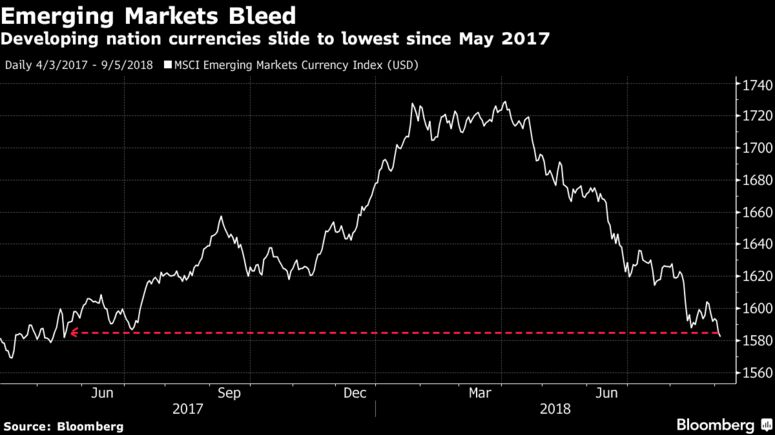
How much worse can the Emerging-Market slump get? Bloomberg Market

Emerging-market assets have further scope to fall, thanks to investors who have been reluctant so far to cut their positions on what's been one of the most popular trades of recent years.

Fund-manager positions are one of the reasons keeping Morgan Stanley's James Lord bearish, even after the MSCI Emerging Market Currencies Index fell to a fresh one-year low. The pressure on developing nations Wednesday rotated into equities, with Hong Kong's benchmark down almost 1 percent and Jakarta's and Manila's sliding nearly 2 percent.

"We stick to a bearish view across credit, rates and FX, and hold short positions across most of the high-beta space, including Indonesia and Malaysia, which are two countries we expect investors to increasingly focus on," Lord and fellow Morgan Stanley strategists wrote in a report Tuesday.


Five years on from the taper tantrum, when worries about a rollback in U.S Federal Reserve stimulus hit riskier assets, emerging economies are beset by the Fed's accelerating destruction of liquidity as it normalizes policy. That's sent funding costs up around the world, casting a pall over countries that have enjoyed faster growth than in developed nations.

"Real money positioning is not yet clean and broader external funding challenges are high," Morgan Stanley analysts concluded, using a term for non-leveraged institutional investors such as mutual and pension funds.

The worst hit nations have been those with the weakest fundamentals. South Africa's rand led global declines Tuesday as data showed its economy fell into a recession. Turkey's lira slid amid concern the nation's central bank will underwhelm investors at its policy meeting next week, while the Argentine peso slumped to a record and Indonesia's rupiah sank to the lowest in two decades even after the central bank intensified its fight to protect it.

JP Morgan Chase & Co. analysis suggests that while investors have largely cut back on their local-currency bond holdings in emerging markets, there's scope for further pullback in stocks and fixed income denominated in dollars and other developed-country currencies.

"EM local currency bond managers appear to have been mostly responsible for the recent EM correction,: JP Morgan strategist including Nikolas Panigirtzoglou wrote in a note Friday. Their analysis showed that active bond-fund managers "abruptly" unwound their positions in local emerging debt last month after building up overweight positions in July. The reversal was so big that it probably amounted to "capitulation," they wrote.

Equity managers, on the other hand, "are far from capitulation territory," having also shifted into an overweight position in July, according to JPMorgan.

"Active EM equity and hard-currency bond fund managers continued to exhibit rather elevated betas during August, suggesting that the EM equity and hard-currency bond universe are more vulnerable in the event of re-escalation in the U.S.-China trade conflict into September, " the JPMorgan team concluded.

For Khiem Do, co-head of Asian multi-asset strategy at Baring Asset Management, there's likely to be more turmoil in the absence of the Fed pulling back on the speed of its policy tightening. And that looks unlikely, bond markets indicate.

"If the Fed were to pause. this would be fantastic news for the EM," he said in a Bloomberg TV interview from Hong Kong. "But the Fed is likely going to hike rates again in September. December we're not sure, they may pause. As soon as they pause, that would be a massive relief for emerging markets."

Source

Monday, September 3, 2018

Oil prices higher as U.S. sanctions limit Iran exports.

LONDON (Reuters)- Oil prices rose  on Monday, supported by concerns that falling Iranian output will tighten markets once U.S sanctions bite from November, but gains were limited by higher supply from OPEC and the United States.

Brent crude oil was up 45 cents at $78.09 a barrel by 0905 GMT. U.S crude was 15 cents higher at $69.95.


The two benchmarks have risen strongly over the last two weeks with Brent gaining more than 10 percent on expectations that global supply will tighten late this year.

U.S sanctions are already curbing exports from Iran.

"Exports from OEPC's third-biggest producer are falling faster than expected and worse is to come ahead of a looming second wave of U.S sanctions," said Stephen Brennock, analyst at London brokerage PVM Oil Associates. "Fears of an impending supply crunch are gaining traction."

Stephen Innes, head of trading for Asia-Pacific at brokerage OANDA, said Brent was "supported by the notion that U.S sanctions on Iranian crude oil exports will eventually lead to constricted markets".

Edward Bell, analyst at Emirates NBD bank in Dubai, agreed:

"Iranian production is already showing signs of decline, falling by 150,000 bpd last month...(as) importers of Iranian barrels will already be moving away from taking shipments."

But global oil markets are still fairly well supplied.

Production by the Organization of the Petroleum Exporting Countries rose 220,000 barrels per day (bpd) in August to a 2018 high of 32.79 million bpd, a Reuters survey showed.

Output was boosted by a recovery in Libyan production and as Iraq's southern exports hit a record high.

U.S. drillers added oil rigs for the first time in three weeks, increasing the rig count by 2 to 862. The high rig count has helped lift U.S. crude production by more than 30 percent since mid-2016 to 11 million bpd.

Meanwhile, trade disputes between the United States and other major economies including China and the European Union are expected to hurt oil demand if they are not settled soon.

China's manufacturing activity grew at a slowest pace in more than a year in August, with export orders shrinking for a fifth month, a private survey showed on Monday.

OANDA's Innes said it was too early to say whether economic slowdown would put a serious dent in oil prices.

"It isn't at all clear that such type of economic headwinds will topple oil prices," Innes said.

Source

Saturday, September 1, 2018

Pentagon cancels aid to Pakistan over record on militants.


WASHINGTON (Reuters) - The U.S. military said it has made a final decision to cancel $300 million in aid to Pakistan that had been suspended over Islamabad's perceived failure to take decisive action against militants, in a new blow to deteriorating ties.

The so-called Coalition Support Funds were part of a broader suspension in aid to Pakistan announced by President Donald Trump at the start of the year, when he accused Pakistan of rewarding past assistance with "nothing but lies & deceit."

The Trump administration says Islamabad is granting safe haven to insurgents who are waging a 17-year-old war in neighboring Afghanistan, a charge Pakistan denies.

But U.S. officials had held out the possibility that Pakistan could win back that support if it changed its behavior.

U.S. Defense Secretary Jim Mattis, in particular, had an opportunity to authorize $300 million in CSF funds through this summer - if he saw concrete Pakistani actions to go after insurgents. Mattis chose not to, a U.S. official told Reuters.

"Due to a lack of Pakistani decisive actions in support of the South Asia Strategy the remaining $300 (million) was reprogrammed," Pentagon spokesman Lieutenant Colonel Kone Faulkner said.

Faulkner said the Pentagon aimed to spend the $300 million on "other urgent priorities" if approved by Congress. He said another $500 million in CSF was stripped by Congress from Pakistan earlier this year, to bring the total withheld to $800 million.

The disclosure came ahead of an expected visit by U.S. Secretary of State Mike Pompeo and the top U.S. military officer, General Joseph Dunford, to Islamabad. Mattis told reporters on Tuesday that combating militants would be a "primary part of the discussion."

Experts on the Afghan conflict, America's longest war, argue that militant safe havens in Pakistan have allowed Taliban-linked insurgents in Afghanistan a place to plot deadly strikes and regroup after ground offensives.

INCREASING PRESSURE

The Pentagon's decision showed that the United States, which has sought to change Pakistani behavior, is still increasing pressure on Pakistan's security apparatus.

It also underscored that Islamabad has yet to deliver the kind of change sought by Washington.

"It is a calibrated, incremental ratcheting up of pressure on Pakistan," said Sameer Lalwani, co-director of the South Asia program at the Stimson Center think tank in Washington.

Reuters reported in August that the Trump administration has quietly started cutting scores of Pakistani officers from coveted training and educational programs that have been a hallmark of bilateral military relations for more than a decade.

The Pentagon made similar determinations on CSF in the past but this year's move could get more attention from Islamabad, and its new prime minister, Imran Khan, at a time when its economy is struggling.

Pakistan's foreign exchange reserves have plummeted over the past year and it will soon decide on whether to seek a bailout from the International Monetary Fund (IMF) or friendly nations such as China.

"They are squeezing them when they know that they're vulnerable and it is probably a signal about what to expect should Pakistan come to the IMF for a loan," Lalwani said. The United States has the largest share of votes at the IMF.

Khan, who once suggested he might order the shooting down of U.S. drones if they entered Pakistani airspace, has opposed the United States' open-ended presence in Afghanistan. In his victory speech, he said he wanted "mutually beneficial" relations with Washington.

A Pakistani official, speaking on the condition of anonymity, said he was unaware of a formal notification of the U.S. decision on assistance but said one was expected by the end of September.

Pakistan has received more than $33 billion in U.S. assistance since 2002, including more than $14 billion in CSF, a U.S. Defense Department program to reimburse allies that have incurred costs in supporting counter-insurgency operations.

Pakistan could again be eligible next year for CSF.

Source

Demands on Greeks were too heavy- Former Eurogroup head.


AMSTERDAM (Reuters) - Euro zone countries have asked for too much fom the Greek people in return for international bailout loans, former Eurogroup chief Jereon Dijsselbloem said in an interview on Dutch television on Saturday.

"On reforms, we asked a lot from the Greek people, too much," Dijsselbloem told current affairs program Nieuwsuur. "Reforms are hard enough to accomplish in a society with well-functioning government, but this was obviously no the case in Greece."

Greece emerged from the biggest bailout in economic history on August 20, after receiving 288 billion euros in financial aid since 2010, with European Union as its biggest lender.

During the crisis, the Greek economy shrank by a quarter, pushing a third of the population into poverty and driving thousands to move abroad.

"Greece is obviously not a success story." Dijsselbloem said. "Their crisis has been so deep, that you can't call it a success."

Dijsselbloem chaired the Eurogroup of euro zone finance ministers from 2013 until the beginning of 2018, and led dozens of lengthy emeergency meetings during which bailouts for Greece, Cyprus and the Spanish banking sector were grudgingly pieced together.

He left national politics after his Labour party was heavily defeated at elections last year, and is set to publish a book on his time as head of the the Eurogroup.

Source

Wednesday, August 29, 2018

U.S Dollar Slides But Treasury Yields Firm.

Capital market continue to digest various narratives getting pushed in many directions but continue to position on a very short horizon given absolute uncertainties, while US equity markets continue to print fresh record highs to start the week. This despite US 10-year yields firming several pips higher overnight.

The S&P 500 breaking 2900 for the first time confirms yet again another bullish break higher. With the NAFTA breakthrough, car-makers were the big winners. But overall the US-Mexico deal has deflected attention away from Trump's legal setbacks as investors may see the light at the end of the tunnel hoping that the US-Sino trade dispute can end in an equally friendly manner.

The firming US yields are likely a result, in the absence of any significant news, of positioning and a growing sense that traders have squeezed about as much juice out of this move as possible.

Oil Markets

Oil prices had fallen after the API reported a crude build when the markets were positioned for a draw while bullish bets remain on Iran sanction sentiment swings. Again, global supply concerns continue to act as a foil against bullish positions as the data does suggest higher global supply than anticipated. However, keep in mind API total was 2.8 million barrels lower than last week's DOE total and so the expected decline may still be there in today's more definitive report. As such, prices are unlikely to fall off the edge on the API data.

Currency Markets

Euro

After a 750 pips, round trip the EURUSD is as likely overbought at 1.1700 as it was oversold at 1.1300. And despite the positivity from this week's IFO Expectations index and some conciliatory overtones from Italy regarding EU budget compliance, with the ECB firmly planted on the sidelines, traders were fading above 1.1700 thinking the 1.1750 could prove a tough nut to crack without a push from the ECB.

Malaysian Ringgit

Trade has been relatively quiet as the ringgit remains thinly traded with Asia traders focused on CNH but with a tepid inflation outlook and the miss on Q2 GDP their likelihood of a rate cut rises which of course will play out negatively for the ringgit.

Chinese Yuan

The market remains fixed on the Counter-Cyclical Mechanism but appears to be biding time just waiting to re-engage long USDCNH positions.


Source

Sunday, June 25, 2017

Bitcoin run could be short lived: AMD, NVIDIA

Advanced Micro Devices Inc.(AMD) and NVIDIA Corp. (NVDA) shares have been surging as investors bet demand for its graphic chip cards used to mine for cryptocurrency will continue unabated.


But while the likes of Bitcoin? and other digital currencies have been seeing huge gains in their prices, prompting scores of people to get into mining the coins, which requires computers with high-end graphics processors, some are warning the party could soon be over, which will pressure shares of both semiconductor companies. The computer-created coins people mine can either be held or sold for a profit.

Miners vs. Gamers
According to a report in MarketWatch, the highly speculative cryptocurrency market has resulted in both companies' graphic cards being hard to come by. When they are available, they often sell for much higher than the manufacturer's suggested retail price. That demand has even prompted Pacific Crest Securities bear to turn bullish and upgrade its rating on NVIDIA to sector weight from underweight. “Meetings with desktop graphics card manufacturers indicated a sharp reversal in sales trends expected for the seasonally weaker 2Q, with surging demand from cryptocurrency miners in China and Eastern Europe," analyst Michael McConnell wrote in a research note to clients. "The sharp increase in demand from cryptocurrency miners has rapidly depleted excess channel inventory carried into the quarter."

But that wild demand also presents a lot of risk given that its only being driven by a speculative market. According to Marketwatch, there are just as many people who are unhappy with the cryptocurrency frenzy as there are who are making a profit from it That’s particularly true of PC gamers who have long been loyal customers to the chip companies. That segment of the market is getting increasingly frustrated when looking for graphic cards from AMD and NVIDIA to purchase. They are not only angry but are shifting their focus elsewhere, which could pressure sales in the future. What’s more, once the cryptocurrency bubble pops or people stop making huge profits, it could result in less demand for their cards, leaving them with excess inventory. Their components could eventually find their way to resale markets, reducing their value significantly. If it happens while the two are in the midst of launching new graphic cards, it could hurt sales as the slightly older hardware is selling for a bargain price, noted Marketwatch.

Source: Investopedia

Monday, June 12, 2017

S&P 500 (SPX) Could fall over 30%,Stockman


Contrarian? market analyst David Stockman, who came to fame as President Reagan's director of the Office of Management and Budget (OMB), sees a "gigantic, horrendous storm" about to hit stocks, sending the S&P 500 Index (SPX) down more than 30% to 1,600, per CNBC. Meanwhile, other market participants are increasingly confident, even as the major indexes continue to reach new all-time highs. For example, the cost of "black swan" insurance, used by hedge funds to protect against sharp stock market declines, has plunged to its lowest level since the financial crisis, as reported by the Financial Times.

This represents a remarkable divergence of opinion about the future direction of the markets.

High Political Risk

Stockman views the controversy over President Trump's firing of FBI Director James Comey as "a huge nothing-burger," per CNBC, and opines that "the system is determined to unseat Donald Trump." Among Stockman's worries, per CNBC, is "hysteria about Russia-gate for which there is no evidence. If they [the Senate] can bog themselves down in this, then we have a dysfunctional, ungovernable situation in Washington." In this environment, and with the August recess for Congress fast approaching, this means that enacting Trump's program of tax reform and infrastructure investment is becoming less likely, Stockman adds. Indeed, Stockman also is concerned about a government shutdown in the next few months, and the possibility that it could erase all the market gains since the election, and more, he told CNBC.

The plunge in the cost of "black swan" insurance reflects a less gloomy view. Nonetheless, investors who agree with Stockman can make 25 times their money if the S&P 500 falls 7% in the next month by purchasing put options on the index. As the FT describes, the one month 97-93 percent put spread on the S&P 500 becomes profitable to the buyer if the index declines by at least 3% over the next month. The maximum profit would be reached if the S&P drops by 7% or more, the FT says, based on data from Bloomberg.

Low volatility in the equity markets, and expectations of continued low volatility in the near future, are key factors behind the low prices of these options contracts, the FT says. In fact, unrepentant bulls also can make similarly outsized gains in the options market. If the S&P 500 rises by 5 to 10% in the next three months, buyers of the three month 105-110 call spread on the index can make 38.5 times their money, the FT computes.

Source: Investopedia


How are Stock Dividends paid to Shareholders?

If a company has excess earnings from which it decides to pay a dividend to common shareholders, the amount is declared along with a payable date. Usually, this is determined quarterly after a company finalizes its income statement. The board of directors meets to review the financial statements and declares a dividend at that time or decides to retain the earnings.

If a dividend is declared, shareholders are notified via press release, which is usually copied into major stock quoting services for easy reference. The record date is set, meaning all shareholders on record on that date are entitled to the dividend payment. The day following the record date is called the ex-date or date the stock begins trading ex-dividend. This means that a buyer on ex-date is purchasing shares that are not entitled to receive the most recent dividend payment. The payable date follows usually about one month after the record date.

On the payable date, the company deposits the funds for disbursement to shareholders with the Depository Trust Company (DTC). Cash payments are then disbursed by the DTC to brokerage firms around the world where shareholders hold the company's shares. The recipient firms appropriately apply cash dividends to client accounts or process reinvestment transactions as per a client's instructions.

Tax implications for the dividend payments vary depending on the type of dividend declared, account type where the shareholder owns the shares, and how long the shareholder has owned the shares. Dividend payments are summarized for each tax year on Form 1099-DIV for tax purposes.

Source: Investopdia

Sunday, January 10, 2016

TV seasons on-demand by Time Warner to fight Netflix.

Time Warner isn't shy about it's disdain for online-only video services like Netflix, which threaten its revenue fro old-school TV providers. However, it's not just going to sit around and gripe- it's planning to do something about it. The media
giant's channels are asking studios to grant them rights to offer full seasons of shows through cable and satellite companies' on-demand services. The hope, as you might have gathered, is that you'll stick to your expensive TV subscription knowing that you can marathon whole seasons like you can on Netflix, Hulu and other services that are friendly to cord cutters.


Will it work? It's hard to say. Studios have sometimes been hesitant to offer those full season rights, since Netflix won't pay them as much if they supply whole seasons to conventional providers. They'd be betting that sheer ubiquity would make up for any hit to their bank account, in other worlds. And that may be a tough sell when streaming-only services are growing rapidly and frequently overshadow the options from TV providers. Still, this could be good news - you might not have to bend over backwards to watch shows fro TBS and TNT (like Rizzoli & Isles) on your own terms.

Sunday, January 3, 2016

BBC Websites taken by DDoS attack

It was reported that BBC websites on early Thursday morning were taken down for around 3.5 hours due to a large cyber attack.Starting at around 2 a.m. ET users who visited the affected websites saw an error message instead of the actual webpages.By 5:30 a.m., the sites were largely working again, though some pages were slow to load.

In a tweet about two hours after the attack began, the BBC said it was aware of the problem and blamed the shutdown on a "technical issue." The broadcaster later published a news story revelaing that it was the victim of a distributed denial of service (DDoS) attack which affected main BBC news site as well as the main iPlayer catch-up service and iPlayer Radio app.

At 6:47 a.m., the BBC tweeted that its websites were back up and running normally.

"We apologise for any inconvenience you may have experienced" , the broadcaster wrote.

For the uninitiated, DDoS attacks aim to flood a website with so many requests that regular traffic is either slowed or completely interrupted.

Meanwhile, the BBC isn't the only prominent company to suffer a DDoS attack in recent days.Gaming company Valve this week revealed it was the target of a Christmas day DDoS attack, which led to a breach of about 34,000 Steam Store users personal information.

Thursday, December 31, 2015

Mercedes' new EV platform for upcoming electric cars

Along with the Porsche Mission E electric super saloon and the Audi Q6 e-tron electric SUV/crossover into production, Mercedes Benz is also into the electric car platform with the reports that they have signed-off on an all new platform for electric vehicle architecture-the EVA platform.This will be used to underpin a quartet of new EVs-two saloon cars and two SUV/crossover models.


The EVA platform is a modification of Mercedes' rear-drive MRA platform, but it will have a space for a battery pack in the floor-just like other EV's and the option to fit an electric motor to drive the rear wheels and also an additional motor at the front for the four-wheel drive variants-with the rear wheel drive variants getting at least 400bhp and the four-wheel drive variants up to 600bhp.

The features include an adaptive electric suspension, recuperative e-brakes and e-torque vectoring, with styling influenced by the Mercedes Concept IAA we saw at Frankfurt a few months ago.


The first new Mercedes Ev to arrive will be a saloon pitched between the C-Class and E-Class, followed by an SUV that will be between the GLC and GLE. The saloon car will arrive in 2018.

Also there will be an S-Class sized saloon car as well as a new super-sized electric SUV which will be bigger than the GLS.

The new Mercedes EVs will be built at Mercedes' Breman plant, with prices expected to start around $103000

Tuesday, December 29, 2015

Photonic Microprocessor created by researchers in US

The University of Colorado Boulder in collaboration with the University of California and MIT announced that they have developed the first photonic microprocessor.


According to Milos Popovic, an assistant professor at Boulder who lead the team in the photonic processors development, the processor uses infrared light with a physical wavelength of less than 1 micron to transmit data between nodes."This enables very dense packing of light communication ports on a chip enabling huge total bandwidth," said Popovic.

The microprocessor uses 850 optical input/output components and has a bandwidth density rated at 300 Gbps per square millimeter, which is roughly 10 to 50 times greater than modern electronic processors currently available.The microprocessor also consumes significantly less power than a modern processor because the energy requirements to generate and transmit  a light signal over distance is significantly lower than in an electronic processor.

"One advantage of light based communication is that multiple parallel data streams encoded on different colours of light can be sent over one and the same medium- in this case, an optical wire waveguide on a chip, or an off-chip optical fiber of the same kind as those that from the Internet backbone," said Popovic.

Although the optical components are responsible for most of the work inside if the processor, the 3x6 mm prototype is actually sort of a hybrid design with electric-based cache and compute cores.


The photonic processor is still in its very early days of development, but if the testing of these prototypes goes well, in a few years we could see a new waves of devices ranging from IoT devices to supercomputers powered by them.

Monday, December 28, 2015

Comcast's new gigabit Internet service aims at Google Fiber.

Comcast announced last week that they installed the first DOCSIS 3.1 modem on a customer's network in Philadelphia, kicking of its new, ultra-fast Internet service.


The DOCSIS (Data Over Cable Service Interface Specification) 3.1 specification is backward-compatible, meaning it works over Comcast's existing hybrid fiber-coaxial network and offers gigabit download speeds. "All we needed was a new modem, a software upgrade to the device that serves that neighborhood, and a few good  engineers," Comcast's Executive VP and CTO Tony Werner wrote in a blog post.

This is in contrast to Google Fiber, which also offers gigabit speeds but requires the installation of a new cable connections to customers' houses.

The upcoming service is different than Comcast's Gigabit Pro service, which brings 2Gbps Internet speeds, but only works in "close proximity" of Comcast's fiber network. The problem with Gigabit Pro is that it costs $300 a month with some pretty outrageous installation/activation fees.

Comcast plans to test the new gigabit technology in more homes "over the coming months" before it starts widely deploying it to customers. Unfortunately, it's not going to happen very soon; the company claims it will start offering a new gigabit speed service "before the end of 2016." There's no word on pricing; as far as coverage goes, Comcast says it's already conducting trials in Pennsylvania, Northern California, Atlanta and Georgia.

Source:Mashable


Sunday, December 27, 2015

Idea Cellular now offering 4G services in major towns of South India.

Idea Cellular, one of the largest Indian telecom operators announced the launch of its high speed 4G LTE services across all five states of South India- Andhra Pradesh, Karnataka, Kerala, Tamil Nadu and Telangana. In the first phase, Idea's high speed 4G network will be available across 75 towns in Southern India.

Major towns to be covered with Idea's 4G LTE services at launch are- Kochi, Hosur, Kadapa, Mallapuram, Mysore, Rajamudry, Tiruchirappalli, Tirunelveli, Tiruppur, Vijayavada and Vishakhapatnam, while Belgaum, Calicut, Cuddalore, Chitradurga, Guntur, Kakinada, Kacheepuram and Trichur will follow by 31st December 2015.Idea will rapidly expand 4G services in all Southern India metros and large towns including Bangalore, Chennai,, Hyderabad, Trivandrum, Mangalore and Coimbatore by March 2016.

Idea is also gearing to launch 4G LTE services by March 2016 in other key markets namely, Madhya Pradesh & Chhattisgarh, Maharashtra and Goa, Punjab, Haryana, North East and Orissa, in a phased manner.By June 2016, Idea's 4G footprint will cover 750 cities across 10 telecom circles.

Idea customers with 4G devices in these 75 towns can now start experiencing super fast speeds by simply upgrading their existing SIM cards to new 4G SIM cards.The company is also offering attractive subscription plans to digital content including a wide range of the latest Music, Movies and Games.Idea has also partnered with leading handset manufactures and e-commerce retailers for special data bundling offers on new 4G smartphones.

Google will bring Project Loon to India soon-Google CEO Sundar Pichai

Technology giant Google hopes to bring its Project Loon to India, which will offer affordable Internet access to millions, soon even as the Government holds the view that the project will interfere with cellular transmissions of mobile operators in the country.

Speaking at the Google for India event, the company's CEO Sundar Pichai said: "Project Loon will launch balloons in the sky to help reach out to rural areas."


Elaborating the same, Google Vice President (Access Strategy and Emerging Markets) Marian Croak said the company is "passionate" about building and deploying new Internet infrastructure around the world.

"One of the technologies that we have in our portfolio is Project Loon.It's a project that we are working on with local telcos all across the world.

"And we are testing these high altitude balloons which literally act as almost like floating cell towers...too connect people in hard to reach regions that are scarcely populated and we are working to hopefully bring Project Loon to India in rural communities that have very few people connected to the Internet," she said.

The statement assumes importance as Communications and IT Minister Ravi Shankar Prasad had recently told Parliament that Google's Project Loon will interfere with cellular transmissions of mobile operators in India.

Croak said the company is working across the world with local carriers, operators and suppliers and does not carry out the project on its own.

Google, under its Project Loon, is using big balloons floating at a height of 20 kilometers above earth surface for transmission of Internet services.It has already tested this technology in new Zealand,California and Brazil.

As per Google, each balloon can provide connectivity to a ground area about 40 kms in diameter using a wireless communications technology called LTE or 4G.

To use LTE or 4G, Project Loon partners with telecom companies to share cellular spectrum so that people will be able to access the Internet everywhere directly from their phones and other LTE-enabled devices.

Google uses solar panel and wind to power electronic equipment in the balloon throughout the day.


Source:NDTV